
Cagrilintide Semaglutide Research Blend: Composition and Evidence Guide
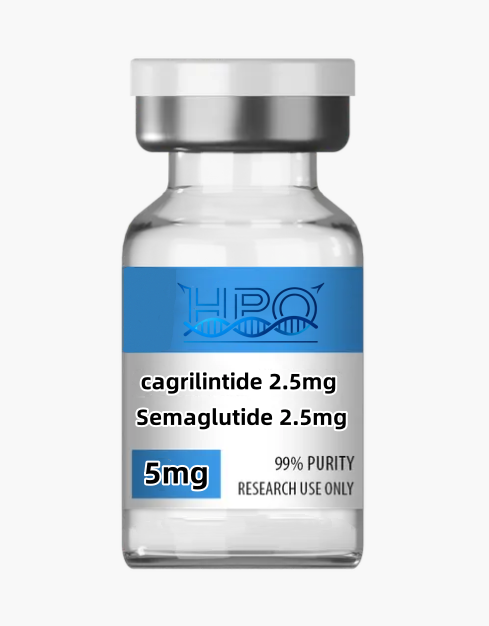
Cagrilintide semaglutide research blend is cataloged with 2.5mg of each component, a nominal total of 5mg. This guide describes the two research pathways, the limits of clinical comparisons, and the documentation needed to characterize a mixed test article. Equal labeled masses do not establish equal molecular amounts, equivalent receptor activity or a validated formulation.
For laboratory research only. Not for human or veterinary use. This commercial material is not represented as the branded clinical-development product CagriSema, an approved medicine or a substitute for prescription treatment. Published trials used specified investigational products under clinical oversight. Their results do not establish the identity, stability, safety or effectiveness of this catalog blend.
Product specifications and identity
| Property | Information for researchers |
|---|---|
| Catalog composition | Cagrilintide 2.5mg + Semaglutide 2.5mg |
| Nominal total and ratio | 5mg; 1:1 by labeled mass, not necessarily by moles |
| Cagrilintide pathway | Amylin and calcitonin receptor pharmacology |
| Semaglutide pathway | GLP-1 receptor pharmacology |
| Chemical identity | Confirm sequence, modifications, counterions and supplied form for each component |
| Molecular formula | No single molecular formula or molecular weight describes the mixture |
| Purity and content | Require separate, lot-specific analytical results; no universal purity percentage is asserted |
| Storage and stability | Follow current lot documentation and validated laboratory procedures |
| Intended use | Qualified laboratory investigation, not personal administration |
Before comparing experiments, establish what the listed amounts represent. Mass may be reported on a free-peptide basis or on an as-supplied basis that includes water and counterions. A chromatographic area percentage cannot resolve this distinction. Researchers should request the calculation basis, suitable reference standards and component-specific content measurements.
A mixture also requires evidence that both intended components remain detectable and adequately separated during analysis. One dominant chromatographic peak does not prove that the other component is absent, pure or correctly quantified. Detector response, co-elution and sample preparation can all affect the apparent composition. Record the analytical method with the result rather than treating a single number as a complete quality assessment.
Two receptor pathways, distinct research questions
Cagrilintide and calcitonin-family receptors
Cagrilintide is a long-acting amylin analog studied at amylin and calcitonin receptors. Structural research published in 2025 examined active receptor complexes and showed interactions with multiple amylin receptor subtypes and the calcitonin receptor. This is more specific than describing cagrilintide as acting on one generic appetite receptor. Receptor composition matters when choosing a cellular model and interpreting a signaling response.
The receptor study provides a mechanistic framework, not a quality certificate for commercially supplied material. Researchers should document the receptor system present in their assay and include suitable reference ligands. A signaling readout from an unidentified cell system cannot, by itself, demonstrate that a response is mediated by the intended receptor.
Semaglutide and GLP-1 receptor signaling
Semaglutide is a GLP-1 receptor agonist. In a laboratory comparison, receptor-specific signaling should be measured in a model appropriate to that pathway. The existence of semaglutide-containing medicines does not make every material sold under the chemical name equivalent to a finished pharmaceutical product. Chemical form, manufacturing controls, formulation and intended use remain separate questions.
For the cagrilintide semaglutide research blend, investigators should distinguish the response attributable to semaglutide from the response attributable to the second component. A combined signal does not identify its source. Appropriate single-component controls and receptor-negative or pathway-selective controls help establish whether an observed effect supports the proposed mechanism.
Combination effects are hypotheses to test
Different targets create a rationale for investigating a combination, but they do not automatically establish synergy. A greater response than either component alone can still be consistent with additivity. Define the comparison model before collecting data, report individual concentrations, and evaluate uncertainty. The catalog ratio should not be described as clinically optimized without formulation-specific evidence.
Clinical literature: what can and cannot be inferred
Early combination research: A randomized phase 1b study evaluated concomitant cagrilintide and semaglutide, including tolerability and pharmacokinetic questions. Its relevance is the controlled investigation of combined exposure. It does not validate a separately sourced, premixed 2.5mg/2.5mg vial or establish that the catalog product has matching impurity and stability profiles.
Phase 2 research in type 2 diabetes: The 2023 active-controlled study compared co-administered cagrilintide and semaglutide with the individual components. Its primary glycemic comparison favored the combination over cagrilintide, but did not reach statistical significance versus semaglutide. This distinction illustrates why a general claim of superiority across all outcomes would be misleading.
REDEFINE 1: The 2025 phase 3 trial examined adults with overweight or obesity without diabetes. It reported greater average body-weight reduction with the studied combination than placebo. These findings belong to the trial population, protocol and investigational product. They are not a forecast for this commercial research blend, and they provide no authorization for personal use.
REIMAGINE 2: A phase 3 report published in 2026 compared the combination with its components in people with type 2 diabetes. Researchers reviewing this newer evidence should examine the specified endpoints, treatment comparisons and analysis populations in the original publication. Findings from different populations and follow-up periods should not be pooled informally into a single marketing claim.
Across these studies, distinguish treatment-policy analyses from analyses estimating outcomes under continued treatment. Also examine discontinuations, missing data and adverse-event reporting. This page does not claim that the mixture eliminates gastrointestinal effects, prevents hypoglycemia, preserves lean mass or has fewer adverse effects than an individual component. Those claims require appropriately designed evidence and cannot be inferred from complementary receptor targets.
Laboratory study design and controls
Define the question: Decide whether the experiment concerns identity, compatibility, receptor activity or another specified endpoint. These questions need different methods. A chemical compatibility result cannot establish clinical efficacy, and a cell response cannot replace structural identification. Prespecify the main endpoint and the criteria for excluding technically invalid samples.
Separate component contributions: Include vehicle, each individual component and the combined material where the design permits. Match analytical concentration bases and document matrix composition. Comparing equal total masses can unintentionally change the amount of each active test substance. Use traceable standards and explain how their assigned content enters the calculations.
Control the model: Document cell identity, receptor expression, passage history and relevant assay conditions. Include viability and interference checks alongside signaling measurements. An apparent loss of signaling may reflect poor cell health or interference with the detector rather than antagonism or pathway desensitization.
Plan analysis: Use independent experimental repeats and distinguish them from repeated measurements of the same preparation. Randomize sample positions and blind analysis when feasible. Report variability, incomplete curves and negative findings. Avoid selecting only the strongest time point after inspecting the results.
Check exposure: Nominal starting content is not necessarily the concentration available throughout an experiment. Container adsorption, degradation and matrix interactions may alter recovery. Analyze relevant samples across the experimental interval and compare freshly characterized material with material exposed to the study conditions.
Quality assurance for a two-component material
A useful certificate of analysis identifies the lot, test dates, methods, acceptance criteria and chemical forms. Request the underlying evidence needed for the intended application. The presence of a certificate does not mean that every potential contaminant, biological endpoint or stability condition has been assessed.
- Identity: Confirm both components using suitable mass and sequence-supporting evidence, including relevant structural modifications.
- Content: Quantify each component independently against appropriate standards, with a stated calculation basis.
- Purity: Review the separation method, detection conditions and related-substance profile. Area purity and mass content are different quantities.
- Compatibility: Assess recovery and degradation in the mixture relative to the separate components.
- Application-specific contaminants: Select relevant tests for the laboratory model; do not infer sterility or endotoxin status from chemical purity.
- Traceability: Link preparation records, analytical results and experimental observations to the same documented lot.
Acceptance limits should be justified before testing. Unexpected peaks or inconsistent recovery merit investigation rather than automatic normalization. Retain raw data, calibration information and deviations so that a later reader can understand how the reported component ratio was established.
Handling, storage and documentation
Follow the current lot label, safety data sheet and institution-approved procedures. Record receipt, opening, storage conditions and excursions. This guide does not assign a universal shelf life or solution-storage period. Those properties depend on the actual formulation, container and validated conditions, not solely on the names of the peptides.
Laboratory preparation requires a method appropriate to the planned analysis, with documented recovery and stability. Appearance alone does not establish identity, chemical integrity or suitability for a biological assay. This page intentionally provides no injection instructions, personal-use dilution scheme or treatment schedule.
Frequently asked questions
1. What is the cagrilintide semaglutide research blend?
It is a catalog mixture labeled with 2.5mg cagrilintide and 2.5mg semaglutide. The amounts describe nominal composition. Researchers must verify each component and its actual content before interpreting experiments.
2. Is this the same product as CagriSema?
No equivalence is represented. CagriSema is the name used for a specific clinical-development combination. Similar ingredient names or a catalog URL containing that name do not establish matching manufacturing, formulation, quality or clinical performance.
3. Does the 1:1 ratio prove synergy?
No. It is a labeled mass ratio, not a biological conclusion. Synergy needs an explicit experimental model and comparison with an expected additive response across appropriately controlled conditions.
4. Can clinical results be applied to this vial?
No direct inference is justified. Trials characterize their specified products and populations. They do not certify the contents, stability, safety or effectiveness of a separately supplied research vial.
5. Why are two content measurements necessary?
A total mass or one purity result can hide an incorrect mixture ratio. Independent measurements help distinguish component content from impurities, water and counterions and make exposure calculations reproducible.
6. Is a human dose recommended?
No. This is a laboratory research listing, not a prescribing resource. Nominal vial amounts and trial descriptions must not be interpreted as administration instructions or substitutes for professional medical care.
7. How should storage suitability be established?
Use current lot documentation and a stability-indicating method appropriate to the mixture. Assess relevant excursions and experimental conditions. Do not borrow a shelf life from an unrelated preparation or assume both components degrade at the same rate.
Related research catalog
These links support separate literature and material comparisons; they are not suggestions for personal-use combinations or substitutions.
- Cagrilintide — component-specific research.
- Semaglutide — GLP-1 pathway research.
- Tirzepatide — a distinct receptor profile.
- Retatrutide — separate multi-receptor literature.
- Survodutide — distinct peptide research material.
- Mazdutide — separate metabolic research context.
- AOD9604 — a different peptide identity.
- Epithalon — unrelated short-peptide characterization.
Primary scientific references
- Cagrilintide receptor structures and dynamics, 2025.
- Concomitant administration: randomized phase 1b study, 2021.
- Combination versus individual components: phase 2 diabetes study, 2023.
- REDEFINE 1: phase 3 overweight and obesity study, 2025.
- REIMAGINE 2: phase 3 component comparison, 2026.
Research-use statement: This material is not offered as a medicine or for human or veterinary consumption. Qualified researchers are responsible for lawful procurement, institutional authorization, safe handling and appropriate disposal. No regulatory approval, clinical benefit or pharmaceutical equivalence is claimed for this specific blend.
Reviews
There are no reviews yet.